October 3, 2026 Highlights of Medicine Buddha Group Practice
By TBSN
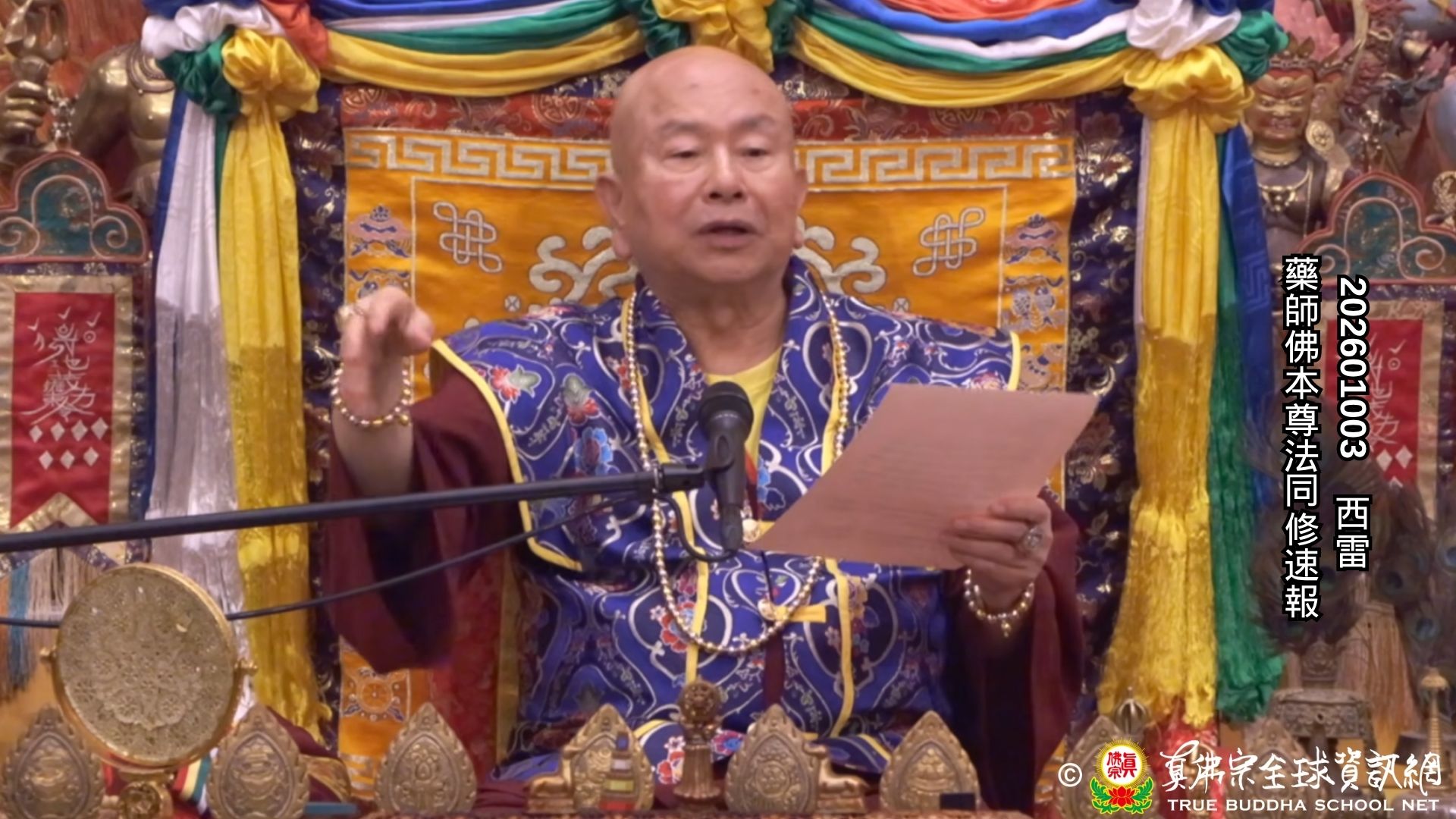
Dharma Discourse by His Holiness
His Holiness has personally seen Medicine Buddha, Sunlight Bodhisattva, and Moonlight Bodhisattva. Medicine Buddha’s retinue includes Sunlight Bodhisattva, Moonlight Bodhisattva, the Eight Great Bodhisattvas, and the Twelve Yaksha Generals. The Twelve Yaksha Generals take turns being on duty according to the months. His Holiness also mentioned that when he was ill in the past, he received blessings from Medicine Buddha.
Why is it possible to remain in a state of non-retrogression in the Western Pure Land of Ultimate Bliss? It is because there are wondrous celestial sounds there that cause sentient beings to open their minds and understand, naturally enabling them to recite the Buddha’s name and cultivate spiritually. In the Pure Land of Medicine Buddha, one also remains in a state of non-retrogression because of the lapis-lazuli light there. When sentient beings see the lapis-lazuli light, their minds and understanding quickly open, and they naturally enter samadhi.
From this, His Holiness explained that each pure land has its own way of delivering sentient beings. In the Pure Land of Fragrance Accumulation, simply eating the rice of Fragrance Accumulation enables one to open one’s mind and understanding and enter samadhi. When Maitreya Bodhisattva descends into this world in the future, the sentient beings of that time will all have good roots of virtue. Maitreya Bodhisattva will be able to transform everyone’s consciousness and deliver them to the Buddha Land.
Q&A
Question from Lotus Annie, Malaysia
Greeting, Grandmaster. Amitabha. May Grandmaster be blessed with good health. I have a question and respectfully ask Grandmaster to answer it compassionately.
We often hear that a person has three souls and seven spirits. Does this mean:
His Holiness’s Answers
The three souls and seven spirits are generally a Taoist concept. Buddhism does not speak of souls and spirits. The soul moves upward, while the spirit moves downward. The soul belongs to the yang, while the spirit belongs to the extreme yin. This is how His Holiness understands it.
Buddhism speaks of Buddha-nature. Buddha-nature is neither outside nor inside. It is like a mineral: only after removing the impurities can one see the gold within. Regardless of whether the three souls and seven spirits return to a pure land, what matters most is that one’s Buddha-nature returns to a pure land. Karma causes practitioners to undergo transmigration, and among the realms of transmigration, the human realm is the best realm for spiritual cultivation.
Regarding the second question, wandering ghosts are also a form of karma. Some ghosts remain in the intermediate state. The realm of the intermediate state is the realm of ghosts. His Holiness himself has also visited the other five realms apart from the human realm. Some beings in the intermediate state have not yet been assigned a destination for transmigration at that particular time, so they can only remain in the intermediate state. They have not escaped the law; their time has simply not yet come.
Regarding the third question, indeed, there is such a teaching. If a being in the intermediate state commits too much evil, it may directly dissipate completely. There are also many different states within the intermediate state, which are difficult to explain clearly. Therefore, the Buddha said that karma is inconceivable.
His Holiness’s Commentary on the Surangama Sutra, Volume Five
Aniruddha rose, bowed at the Buddha’s feet, and said to the Buddha that when he first ordained, he was constantly sleeping. When Shakyamuni Buddha was teaching the Dharma, Aniruddha himself would also fall asleep below. Shakyamuni Buddha once rebuked Aniruddha, saying that if he continued like this, he would be reborn as a clam. After hearing this, Aniruddha vowed not to close his eyes for seven days, resulting in him becoming blind.
His Holiness explained that if a person is not distracted, then everything else they do will also not be distracted, because a practitioner who is naturally not distracted will not engage in actions that cause them to become distracted. When the mind is undistracted, this is called samadhi; being distracted is the state of ordinary beings. His Holiness said that through this, we should develop awareness. If spiritual cultivation is too pleasurable, one may become distracted; if it is too arduous, one may turn to asceticism. Aniruddha, for example, went too far in this direction, resulting in his becoming blind.
His Holiness continued to explain that the Buddha then taught Aniruddha the Samadhi of Joyful Vision and Illumination, through which he could see the Dharma realms of the ten directions with his own mind. Aniruddha’s seeing did not depend on his eyes, yet he could see the Dharma realms of the ten directions as though he were holding a fruit in the palm of his hand. The Buddha certified that Aniruddha had attained the Arhat fruit.
Now, when the Buddha asked how the wondrously luminous true mind could be realized, Aniruddha answered that, according to his own cultivation and realization, it was through entering samadhi.
His Holiness has said that when he closes his eyes, it may appear that he is dozing, but in actuality, he can see the phenomena of the Dharma realms of the ten directions. In this state, a practitioner’s mind is undistracted, and naturally, the practitioner can attain realization.

You are now formally a member. Please sign in to fully utilize your privileges.
We will send an authentication letter to your registered email account. Please verify that you have received the letter in your inbox. The authentication letter will be mailed within 5-10 minutes after registration. If you do not receive the authentication letter, please check if the letter is located in Spam.


 English