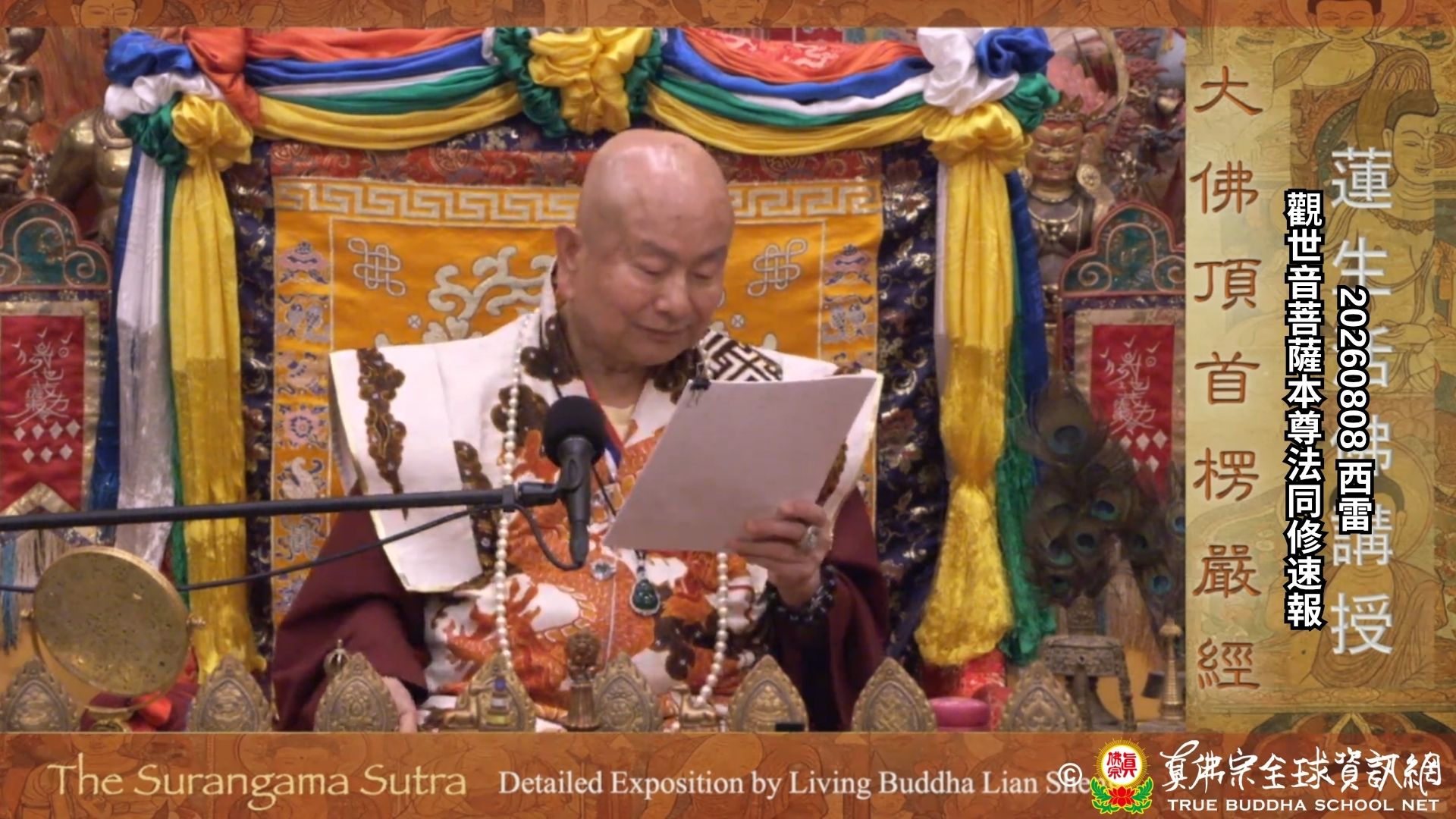
August 8, 2026 Highlights of Avalokiteshvara Bodhisattva Principal Deity Group Practice
By TBSN
Dharma Teaching by HH Living Buddha Liansheng
The Bible mentions, “It is more blessed to give than to receive.” In other words, those who give are more blessed than those who receive. His Holiness’ realization is that mind, Buddha, and sentient beings are not different. When you give a gift to another person, it is the same as giving it to yourself. What you give will eventually be returned to you, and you may receive even more in return. Among the Six Paramitas, His Holiness encourages everyone to practice generosity more often because generosity brings blessings and merits.
His Holiness said that he has not wasted this lifetime because he has finally understood the principles of this universe. Compassion represents Avalokiteshvara Bodhisattva, joyful generosity represents Mahasthamaprapta Bodhisattva, benevolence represents Shakyamuni Buddha, and integrity represents Amitabha Buddha. Joyful generosity means giving happily and willingly.
At this year’s Fall Grand Ceremony, His Holiness will share with everyone his realization of the Way. A practitioner who can realize the Way will develop a vast and expansive mind. Why do people fail to get along with one another? This is a matter of the scope of the mind. Those who have attained the Way take sentient beings as their starting point, while those who have not attained the Way take themselves as their starting point. A person with a broad mind can accommodate everything, and naturally, many things will not weigh on the mind.
Q&A
Question from Lotus Chen Yingzhu (Canada)
I respectfully pay homage to the most venerable Grandmaster.
Please enlighten me, Grandmaster. When I returned to my home country to visit relatives, I purchased several Mahabala thangkas from a Dharma brother from my hometown. Since it was a Dharma sister’s birthday, I gave one of the thangkas to her as a gift. When she opened it, she said that Mahabala depicted in the thangka did not have Ksitigarbha Bodhisattva above him and therefore was not in accordance with the Dharma. She also said that Grandmaster should not be depicted above Mahabala and that Ksitigarbha Bodhisattva should be there instead. Therefore, she refused to accept it.
Is what this Dharma sister said correct?
His Holiness’ Answer
A thangka is an appearance. There is one appearance when you are young and another when you are old. When a practitioner reaches the Western Pure Land, all the Padmakumara he sees are Grandmaster. Mahabala is originally an envoy of Ksitigarbha Bodhisattva. Among the three principal deities of Grandmaster, one is Ksitigarbha Bodhisattva. In the future, Grandmaster will be in Amitabha Buddha’s Pure Land, in the realm of the Golden Mother of the Jade Pond, and alongside Ksitigarbha Bodhisattva. This is what is meant by the countless billions of transformation bodies.
Padmakumara is actually a transformation body of Amitabha Buddha; their origins are the same. Living Buddha Liansheng is a Padmakumara, representing a manifestation of Buddha who has come to the human world to propagate the Buddhadharma. As long as a practitioner understands what oneness means, they will not become attached to appearances. Once one understands the oneness of all things, one will not become attached to who appears in a particular depiction.
The one seated on the Dharma throne is Grandmaster, while in the Maha Twin Lotus Pond is Padmakumara. Padmakumara is a transformation body manifested by Amitabha Buddha. When a practitioner does not grasp at appearances, the mind naturally becomes vast and expansive. All appearances are Buddha.
The one seated on the Dharma throne is the Root Guru; the one in the Mahā Twin Lotus Ponds is the Lotus Youth. The Lotus Youth is an emanated youth manifested by Amitābha Buddha. When practitioners do not grasp at appearances, their minds naturally become vast. All appearances are Buddha.
His Holiness’ Commentary on the Surangama Sutra, Volume Five
Shakyamuni Buddha at this time took the knotted khata and pulled it first with his left hand and then with his right hand. Each time, he asked Venerable Ananda whether the knot could be untied that way. Venerable Ananda replied that it could not. Since even pulling the knots with either the left or right hand could not untie them, Shakyamuni Buddha asked Ananda how he would untie the knots.
Venerable Ananda told Shakyamuni Buddha that as long as one worked from the center of the knot, the knot would naturally come undone. Shakyamuni Buddha said that was correct: to untie the knot in the khata, one must begin at the center of the knot.
Shakyamuni Buddha then told Venerable Ananda that the Buddhadharma arises from causes and conditions, rather than from the coarse appearances formed through the combination of worldly causes and conditions. The phenomena of the mundane world belong to coarse appearances, while the supermundane Dharma belongs to subtle appearances. When a practitioner generates supermundane causes, there will be supermundane results, which are subtle results. When a practitioner creates worldly causes, these belong to coarse appearances and will result in the cycle of rebirth within the Six Realms.
His Holiness used a hand drum as an example. A hand drum is a coarse appearance formed through the combination of wood, rubber, and copper. A vajra bell is made of copper, which is extracted from minerals. Human beings are composed of earth, water, fire, and wind, while houses are made of wood. All these tangible things are composite appearances and are coarse appearances. A mind that creates coarse appearances produces coarse results. Only a mind that creates subtle appearances can produce subtle results.
Shakyamuni Buddha said that one must understand causes in order to attain the sacred fruit. At that time, the practitioner will understand everything, even the origin of a single drop of water falling in a very distant place. The practitioner will even understand the origins of pine trees, crows, swans, and all such phenomena.
Venerable Ananda chose the six sense faculties. Once the knots in these six faculties are removed, the coarse appearances naturally disappear. All delusional thoughts and false notions will vanish, and the wondrously luminous true mind will then manifest. When all the dust of the mundane world has disappeared, if the wondrously luminous true mind does not manifest at that moment, when else would it appear? This is what Shakyamuni Buddha told Venerable Ananda.
His Holiness told everyone: By using a supermundane mind to cultivate the supermundane Dharma, one can untie the knots within one’s own mind and then behold one’s own wondrously luminous true mind.


You are now formally a member. Please sign in to fully utilize your privileges.
We will send an authentication letter to your registered email account. Please verify that you have received the letter in your inbox. The authentication letter will be mailed within 5-10 minutes after registration. If you do not receive the authentication letter, please check if the letter is located in Spam.


 English