True Buddha School Dharma Transmission Department Ayushmats Council Announcement
Clarification on the Proper Understanding of Seeking the Dharma in Vajrayana — With Additional Remarks on Empowerment, Online Group Practice, and the Attitude of Reverent Learning
Document No.: Dharma Explanation Declaration No. 003
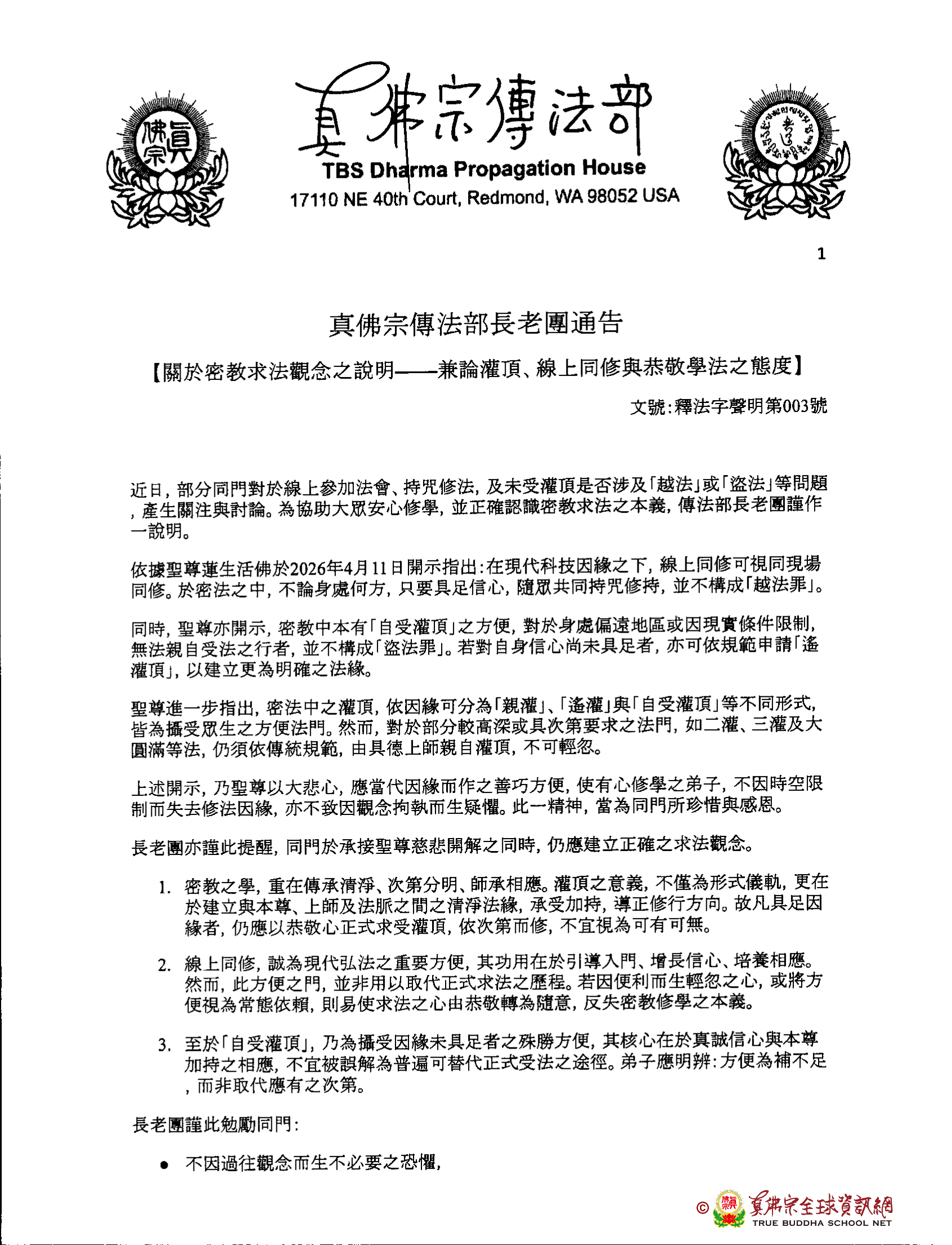
Recently, some disciples have expressed concerns and engaged in discussions regarding participation in ceremonies online, mantra recitation and practice, and whether practicing without having received empowerment constitutes “overstepping the Dharma” or “stealing the Dharma.” To help everyone practice with peace of mind and to correctly understand the fundamental meaning of seeking the Dharma in Vajrayana, the Ayushmats Council of the Dharma Transmission Department hereby provides the following clarification:
According to the teaching given by His Holiness Living Buddha Liansheng on April 11, 2026: under modern technological conditions, participating in online group practice may be regarded as equivalent to in-person participation. Within Vajrayana practice, regardless of one’s location, as long as one has sufficient faith and joins the assembly in mantra recitation and cultivation, this does not constitute the offense of “overstepping the Dharma.”
At the same time, His Holiness also taught that Vajrayana includes the expedient method of “self-empowerment.” For practitioners who reside in remote areas or are unable, due to practical limitations, to receive teachings in person, this does not constitute the offense of “stealing the Dharma.” For those whose faith is not yet firmly established, they may also apply, in accordance with regulations, for “remote empowerment” in order to strengthen their connection with the Dharma.
His Holiness further pointed out that empowerment in Vajrayana, depending on causes and conditions, may be categorized into forms such as “in-person empowerment,” “remote empowerment,” and “self-empowerment.” All of these are expedient means intended to benefit sentient beings. However, for certain more advanced or stage-specific practices, such as Level-2 Empowerment, Level-3 Empowerment, and Great Perfection (Dzogchen), it remains necessary to follow traditional requirements and receive empowerment personally from a qualified master; this must be approached with due seriousness.
The above teachings are expedient means given by His Holiness out of great compassion in response to present-day conditions. They allow sincere practitioners not to lose opportunities for practice due to limitations of time and space, while also preventing unnecessary doubt or fear arising from rigid or mistaken views. This spirit should be cherished and appreciated by all disciples.
The Ayushmats Council also wishes to remind everyone that, while receiving His Holiness’s compassionate guidance, it remains essential to establish a correct understanding of seeking the Dharma:
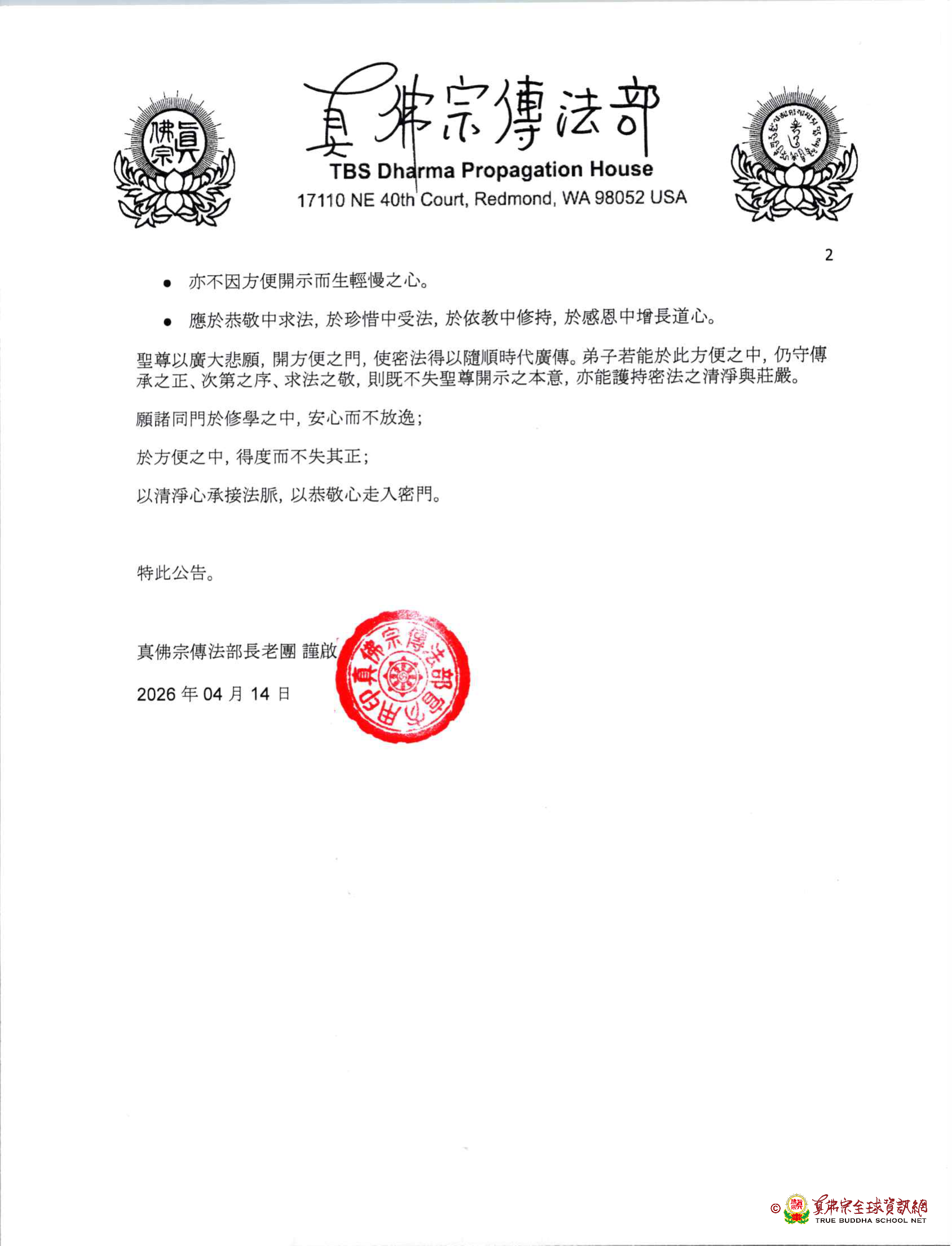
The Ayushmats Council hereby encourages all disciples:
With vast compassion and great vows, His Holiness has opened the gate of expedient means, allowing Vajrayana teachings to spread in harmony with the times. If disciples can make use of these expedient methods while upholding the integrity of the lineage, the proper order of practice, and a reverent attitude toward seeking the Dharma, they will neither lose the original intent of His Holiness’ teachings nor compromise the purity and dignity of the Vajrayana tradition.
May all disciples, in their cultivation, remain at ease without becoming lax;
Within expedient means, attain liberation without losing correctness;
Receive the lineage with a pure mind, and enter the gate of Vajrayana practice with reverence.
True Buddha School Dharma Transmission Department Ayushmats Council
April 14, 2026




You are now formally a member. Please sign in to fully utilize your privileges.
We will send an authentication letter to your registered email account. Please verify that you have received the letter in your inbox. The authentication letter will be mailed within 5-10 minutes after registration. If you do not receive the authentication letter, please check if the letter is located in Spam.


 English