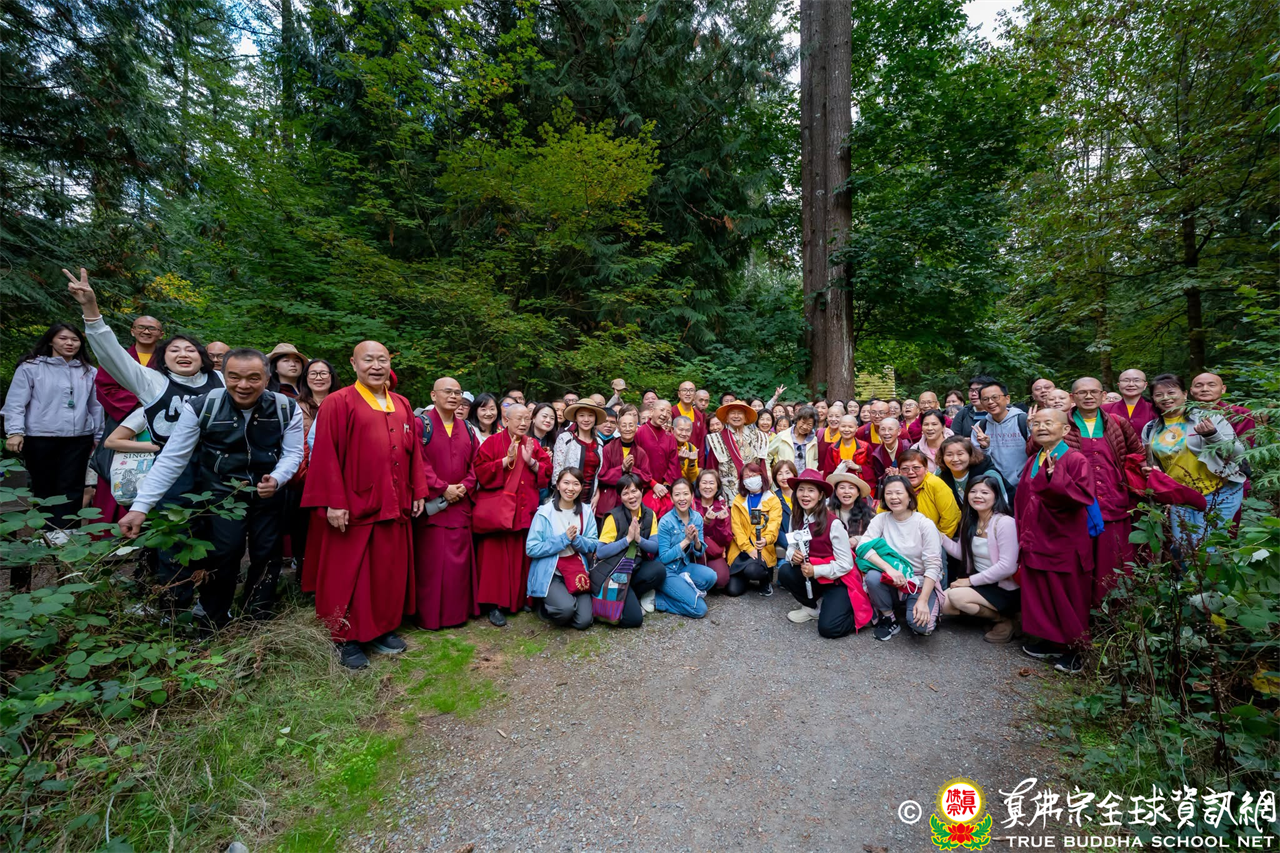
Rejoicing with Buddha: Living Buddha Liansheng and Shimu Enjoy a Forest Walk at Tiger Mountain
By Master Shi Lianyi, Ling Shen Ching Tze Temple, Seattle
On the afternoon of September 23, 2026, “Rejoicing with Buddha” arrived at its sixth destination. More than 110 Masters, Reverends, Dharma propagating personnel, and disciples from Lei Sheng Ching Tze Temple and Rainbow Temple accompanied HH Living Buddha Liansheng and Shimu Master Lianxiang to Tiger Mountain in Issaquah. They entered the forest trails around Tradition Plateau and enjoyed a relaxing “forest bath” amid the early autumn woods.
Although it was called Tiger Mountain, there was no intention of reaching the summit today.
Together with nearby Squak Mountain and Cougar Mountain, Tiger Mountain forms what is known as the Issaquah Alps. The Tradition Plateau area lies at the northwestern foot of Tiger Mountain. With its gentle terrain and a landscape of forests, lakes, and wetlands, it was an ideal place to walk slowly and take in the surroundings.
By late September, autumn had quietly begun to arrive on Tiger Mountain. Unlike the mountains of the eastern United States, which can be covered in brilliant red fall foliage, the scenery here was dominated by the deep green characteristic of the Pacific Northwest. Among the tall Douglas firs, western red cedars, and western hemlocks, ferns covered the forest floor, while moss spread along tree trunks and fallen logs. Here and there, bigleaf maples were beginning to change color.
As the group of more than 100 people entered the forest, the narrow trail immediately stretched into a long line of people.
Along the way, Master Lianqi (蓮麒) carefully pointed things out to everyone, reminding them not to focus only on moving forward, but also to look at the ferns by their feet, the moss on the trees, and the holes left by woodpeckers, and to listen to the birds singing in the forest.
“If everyone is a little quieter, you can hear many birds singing.”
Still, with more than 100 people traveling together, becoming truly quiet was not easy. It may be difficult to say how many bird calls were actually heard. The sounds of conversation and laughter along the way, however, had already traveled deep into the forest with the long procession.
Despite the liveliness, everyone was very considerate of other trail users. Whenever walkers or runners approached from the opposite direction, someone at the front would remind the group, and everyone would quickly move to one side of the trail and stop to let the other visitors pass. The long procession thus made way again and again along the narrow forest trail.
As Guru Buddha walked, He also kept an eye on the disciples around Him.
When he noticed that some people were slowing down, Guru Buddha joked, “If you walk too slowly, watch out or a bear will eat you!”
Tiger Mountain does have documented sightings of black bears and other large wildlife. Although the chance of actually encountering them on a busy forest trail is low, after Guru Buddha’s reminder, the footsteps of those at the back of the group seemed to become a little quicker.
Some disciples wanted to stay closer to Guru Buddha and simply walked onto the slope beside the trail. Seeing this, Guru Buddha immediately reminded everyone to watch their footing and stay safe, then joked that if someone fell, they would have to perform a “heroic rescue of a damsel in distress.”
A reminder was often accompanied by a joke.
Along the way, Guru Buddha also teased a young boy named Xiaosheng who was with the group, joking that Xiaosheng only paid attention to beautiful women and ignored Guru Buddha.
Hearing this, Xiaosheng simply stuck his little fingers into his ears.
Another burst of laughter rose from the group.
When they came upon two trees growing closely together, Guru Buddha took one look at them and said, “The Lovers’ Trees.”
With that one remark, two ordinary trees in the forest instantly became a popular spot for everyone to admire and photograph.
Farther along, Guru Buddha saw someone stacking stones one on top of another. He stopped and talked about the stone towers commonly seen in Japan, explaining that there is merit in stacking stones into towers as well. A pile of unremarkable stones in the forest thus became another topic for a spontaneous Dharma conversation along the way.
The forest through which everyone walked appeared pristine and secluded, but it also contains a chapter of Tiger Mountain’s development history.
From the late nineteenth to the early twentieth century, the Tiger Mountain and Issaquah area experienced extensive logging. Much of the lush forest seen today actually regrew after the logging operations of that era. There were once logging railways in the mountains that transported timber to sawmills. Some of today’s wider, flatter trails developed along the old railroad grades.
One of the most interesting historical traces in the forest is the weathered old bus beside the trail.
According to research by the Issaquah History Museums, this bus, dating to around 1930, was used by a logging company to transport workers up the mountain. It was later used as a bunkhouse at a logging camp and was abandoned in the 1950s. After decades of exposure to wind and rain, the bus has become heavily rusted and weathered. Today, it has instead become a favorite photo spot for visitors. The trail itself even came to be known as the “Bus Trail” because of it.
When Guru Buddha walked up to the old bus and looked at the space inside, He joked, “It’s just the right place to hide and go number one.”
Everyone burst out laughing again.
The forest trail winds around Tradition Lake. This lake is quite different from Lake Sammamish, which “Rejoicing with Buddha” visited last time. Lake Sammamish is broad and expansive, while Tradition Lake is a small lake tucked among forests and wetlands, with its surface only occasionally visible through the surrounding foliage.
From a higher point along the trail, the group looked through the trees toward the lake. The still water stretched quietly across the view, with patches of water lilies floating on its surface. It lacked the grandeur of towering mountains and vast bodies of water, but possessed a tranquil beauty, enclosed layer upon layer by the surrounding forest.
These seemingly ordinary ferns, mosses, and small forest lakes are precisely what make the forests of western Washington so characteristic.
This “Rejoicing with Buddha” outing was not about reaching a particular mountain summit or completing a particular loop trail.
Everyone simply followed Guru Buddha and Shimu as they slowly made their way through the forest.
They occasionally stopped to look at a tree. Some took photographs, some chatted and laughed, while others simply enjoyed the forest air in silence. The group of more than 100 people stretched into a long procession through the woods, becoming a distinctive sight that afternoon.
As the outing drew to a close, Guru Buddha said, “Walking the forest trail today was very nice. It wasn’t too hot or too cold. Just right.”
The words “just right” also perfectly captured the feeling of this forest bath.
There was no need to reach the summit and no need to hurry.
They looked at some moss, identified a fern, and gazed at a small lake among the trees. Guru Buddha and Shimu were there alongside the disciples, with laughter rising and falling throughout the group, accompanied by the just-right coolness of the early autumn forest.
The forest was originally very quiet.
It was just that the laughter of more than 100 people traveled farther than the birdsong.




You are now formally a member. Please sign in to fully utilize your privileges.
We will send an authentication letter to your registered email account. Please verify that you have received the letter in your inbox. The authentication letter will be mailed within 5-10 minutes after registration. If you do not receive the authentication letter, please check if the letter is located in Spam.


 English