Rejoicing with Buddha: Living Buddha Liansheng and Shimu Revisit Lake Sammamish
News from Ling Shen Ching Tze Temple, Seattle / By Master Shi Lianyi (蓮屹)
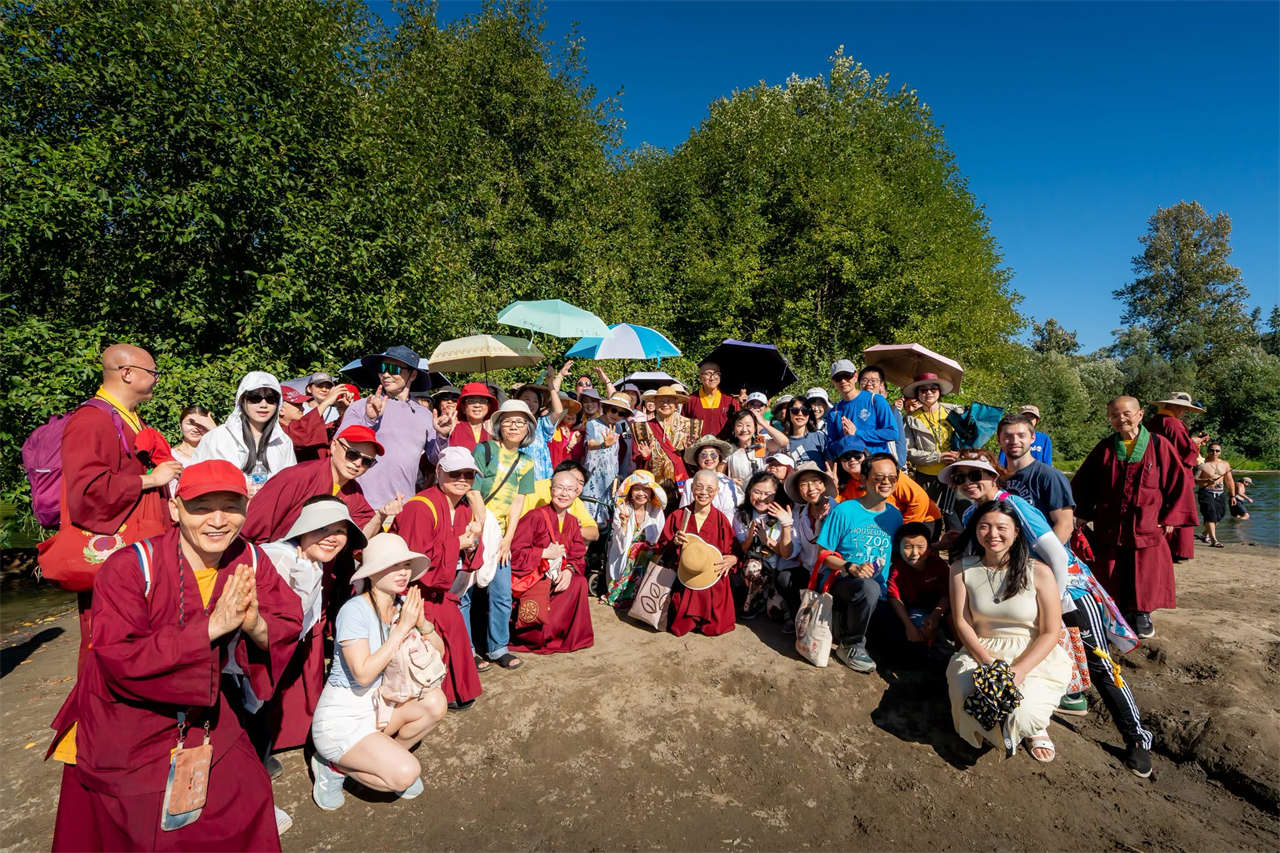
On the afternoon of August 20, 2026, the fifth stop of Rejoicing with Buddha brought everyone to Lake Sammamish State Park. Masters, Reverends, Dharma propagators, and fellow disciples from Ling Shen Ching Tze Temple and Rainbow Temple accompanied Living Buddha Liansheng and Shimu, Master Lianxiang, on a walk along the Issaquah Creek Natural Habitat Trail, where they appreciated the ecosystems along the lakeshore and creek.
This stop held special significance.
More than forty years ago, Guru Buddha lived by Lake Sammamish. His lakeside experiences of swimming, fishing, meditating, reciting mantras, watching fish, and spiritual cultivation were later collected in his 60th book, The Inner World of the Lake, published in 1985. In a later writing, Guru Buddha even referred to Lake Sammamish as the “hometown of my life’s journey.”
Today, Rejoicing with Buddha returned to this very lake.
It happened to be the hottest day of the week, and the sun was particularly intense. However, the Issaquah Creek Natural Habitat Trail was lush with trees and offered abundant shade, while the creek flowed quietly through the woods. Shimu, Master Lianxiang, remained in excellent physical condition, walking briskly throughout the journey and keeping up with the group without ever falling behind.
The focus of this walk was to learn about the salmon’s “journey home.”
Along the way, Master Lianqi (蓮麒) carefully introduced the different species of salmon, their ecology, and the routes they follow each year as they return to their spawning grounds. Adult salmon return from the Pacific Ocean to Puget Sound, pass through the Ballard Locks into Lake Washington, then swim up the Sammamish River to Lake Sammamish, and finally return to Issaquah Creek to spawn.
For adult salmon, this is a journey home. When the new generation of young salmon matures, they in turn follow the same waterway out of the creek and toward the ocean.
Master Lianqi also explained that there are four species of salmon in this area. Kokanee are particularly unique because, unlike other migratory salmon, they do not enter the Pacific Ocean but complete their entire life cycle in freshwater. The fallen logs and tree trunks scattered throughout the creek, though seemingly disorderly, also play an important role. They create shelter and calmer waters where young fish can hide from predators.
As everyone walked and listened, what had seemed like an ordinary creek running through the woods came alive with the story of generations of salmon traveling back and forth through these waters.
Throughout the walk, while Guru Buddha admired the natural scenery, he also frequently looked after everyone's safety.
When he saw thorny plants beside the trail, Guru Buddha reminded everyone to walk carefully and not get pricked. He then immediately joked that otherwise, it would be like falling into the Passionless Valley and being poisoned by the passion flower, and there would be no cure.
Everyone burst into laughter.
When they reached the creek, he jokingly reminded everyone again, “Don't fall into the water and get eaten by the alligators!”
The disciples immediately replied with laughter, “There are no alligators here, only salmon!”
One reminder and one response instantly filled the shaded trail with laughter once again.
Walking beside these familiar waters, Guru Buddha naturally began sharing memories from many years ago.
Guru Buddha recalled swimming in Lake Sammamish in his early years and even diving down to the bottom of the lake. Although the surface appeared calm, there were actually underwater currents below. He also remembered hearing unusual sounds while underwater. These memories echo the descriptions of the lake, its sounds, and his experiences of spiritual cultivation written in The Inner World of the Lake.
Guru Buddha also recalled how someone once took him fishing by the creek. They placed a basket into the water and then lifted it back up, only to find it filled with salmon. The sheer number of fish left a deep impression on him to this day.
When speaking of fishing by the lake in those days, Guru Buddha remembered even the smallest details.
The fish here had small mouths, so small hooks had to be used. As for bait, red earthworms, not black earthworms, were best. Why?
Guru Buddha smiled and said, “Red earthworms smell better.”
Once again, everyone laughed.
In The Inner World of the Lake, Guru Buddha wrote about fishing by the lake using fishing line, stones, hooks, and red earthworms. Even the detail of the “red earthworms” matched exactly what he had written forty-one years earlier. Through these few lighthearted conversations, those days of fishing by the lake suddenly came vividly to life once again.
After completing the Issaquah Creek Natural Habitat Trail, the group did not continue along the rest of the originally planned route. Instead, everyone went directly to the area near Sunset Beach to rest beneath the shade of the trees by the lake.
The temple had already prepared popsicles and ice cream in a variety of flavors, along with beverages and fresh fruit. After walking for some time, everyone settled beneath the large trees, cooling off, chatting, and relaxing. Guru Buddha and Shimu also chatted casually with the disciples. Some admired the scenery, some enjoyed fruit, and some fellow disciples even picked up hula hoops and began playing.
There was no rush to complete the entire itinerary, nor was there any need to walk any farther.
Everyone simply sat beneath the trees, eating ice cream, chatting, and laughing.
Setting out beneath the most intense sun of the week might ordinarily have made for a tiring outing. However, with the breeze from the lake and Guru Buddha and Shimu accompanying everyone along the way, the group talked and laughed, and before they knew it, a delightful afternoon had passed.
Salmon leave the creeks where they are born and swim out to the ocean. After many years, they follow the waterways back to where their journey began. More than forty years ago, Guru Buddha swam, fished, listened to the sounds of the lake, watched the fish along these shores, and eventually wrote The Inner World of the Lake. Today, accompanied by Shimu and his disciples, he returned once again to walk beside the lake, and memories of those days were revisited through conversation and laughter along the way.
The salmon returned home.
Guru Buddha, too, revisited the lake of his past.
Today’s Rejoicing with Buddha did not cover every part of the park. Yet among the creek, the lake, and the shade of the trees, it left behind another chapter of The Inner World of the Lake, one belonging to this very day.



You are now formally a member. Please sign in to fully utilize your privileges.
We will send an authentication letter to your registered email account. Please verify that you have received the letter in your inbox. The authentication letter will be mailed within 5-10 minutes after registration. If you do not receive the authentication letter, please check if the letter is located in Spam.


 English